• Cart$0
  • Log In
  • Cart
  • Checkout

  • About
    • Why Born To Draw?
    • Programs
      • Educators
      • Born to Draw for Homeschool Parents and After School Programs
      • Born to Draw for Adult Beginning Drawers
    • Art Projects/Curricula
    • Visual Literacy
    • Links
    • Contact Us
  • Learn
    • Teaching Resources
      • Teacher Training for Art Program iBooks
    • Art Education Projects
    • Videos
    • Materials
      • Materials: Adult Watercolor Class
      • Materials: Born to Draw Children’s Art Drawing Program
      • Materials: BTD Teachers Classroom List and by Child
      • Materials: Classroom List for Step-By-Step Drawing
      • Materials: Color Pencil Drawing and Rendering
      • Materials: Drawing Basics
      • Materials: Pastels
      • Materials: Mixed Media
      • Buy Materials at Dick Blick
  • Books
    • Born to Draw: Children’s Art Drawing Program
    • Born To Draw: Drawing for Holidays and Special Occasions
    • Drawing Perspective
    • More iBooks
    • Apple Volume Purchase Program
  • Art Room
    • Children’s Art Gallery
    • Submit a Drawing
    • ArtMakers Contest
  • Workshops
    • Upcoming
    • All
    • About Workshops
    • Workshops Overview
  • Blog
  • Shop
  • Members
    • Member Login
    • Register

Blog

  • Follow us on Twitter
  • Join our Facebook Group
  • RSS

New NEA Research Report shows potential benefits of arts education for at-risk youth

this entry has 0 Comments/ in Blog, Previews / by Elaine Cimino
April 2, 2012

The Arts and Achievement in At-Risk Youth study uses four separate longitudinal studies (three from the U.S. Department of Education) to track children, teenagers, and young adults who had high or low levels of arts engagement in or out of school. Those activities included coursework in music, dance, theater, or the visual arts; out-of-school arts lessons; or membership, participation, and leadership in arts organizations and activities, such as band or theater.

WASHINGTON, DC.- At-risk students who have access to the arts in or out of school also tend to have better academic results, better workforce opportunities, and more civic engagement, according to a new NEA report, The Arts and Achievement in At-Risk Youth: Findings from Four Longitudinal Studies.
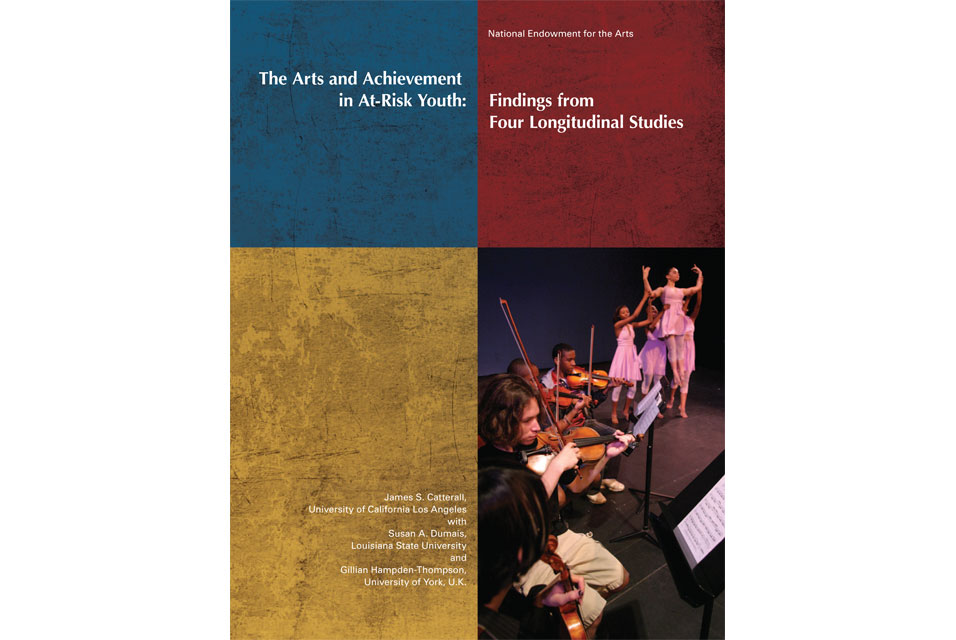


The study reports these and other positive outcomes associated with high levels of arts exposure for youth of low socioeconomic status. The Arts and Achievement in At-Risk Youth study uses four separate longitudinal studies (three from the U.S. Department of Education) to track children, teenagers, and young adults who had high or low levels of arts engagement in or out of school.

Those activities included coursework in music, dance, theater, or the visual arts; out-of-school arts lessons; or membership, participation, and leadership in arts organizations and activities, such as band or theater. The study focuses on the potential effects of arts engagement on youth from the lowest quarter of socioeconomic status.

Although most of the arts-related benefits in this report applied only to these at-risk youth, some findings also suggest benefits for youth from advantaged backgrounds. “Arts education doesn’t take place in isolation,” said NEA Chairman Rocco Landesman. “It has to take place as part of an overall school and education reform strategy. This report shows that arts education has strong links with other positive educational outcomes.”

Among the key findings: Better academic outcomes –
Teenagers and young adults of low socioeconomic (SES) status who have a history of in-depth arts involvement (“high arts”) show better academic outcomes than low-SES youth with less arts involvement (“low arts”). They earn better grades and have higher rates of college enrollment and attainment.
• Low-SES students who had arts-rich experiences in high school were ten percent more likely to complete a high school calculus course than low-SES students with low arts exposure (33 percent versus 23 percent).
• High-arts, low-SES students in the eighth grade were more likely to have planned to earn a bachelor’s degree (74 percent) than were all students (71 percent) or low-arts, low-SES students (43 percent).
• High-arts, low-SES students were 15 percent more likely to enroll in a highly or moderately selective four-year college than low-arts, low-SES students (41 percent versus 26 percent).
• Students with access to the arts in high school were three times more likely than students who lacked those experiences to earn a bachelor’s degree (17 percent versus five percent).
• When it comes to participating in extracurricular activities in high school, high-arts, low-SES students are much more likely also to take part in intramural and interscholastic sports, as well as academic honor societies, and school yearbook or newspaper — often at nearly twice or three times the rate of low-arts, low-SES students. Higher career goals — There is a marked difference between the career aspirations of young adults with and without arts backgrounds.
• High-arts, low-SES college students had the highest rates of choosing a major that aligns with a professional career, such as accounting, education, nursing, or social sciences (30 percent), compared to low-arts, low-SES students (14 percent) and the overall SES sample (22 percent).
• Half of all low-SES adults with arts-rich backgrounds expected to work in a professional career (such as law, medicine, education, or management), compared to only 21 percent of low-arts, low-SES young adults. More civically engaged – Young adults who had intensive arts experiences in high school are more likely to show civic-minded behavior than young adults who did not, with comparatively high levels of volunteering, voting, and engagement with local or school politics. In many cases, this difference appears in both low-and high-SES groups.
• High-arts, low-SES eighth graders were more likely to read a newspaper at least once a week (73 percent) compared to low-arts, low-SES students (44 percent) and the overall SES sample (66 percent).
• High-arts, low-SES young adults reported higher volunteer rates (47 percent) than the overall sample and low-arts, low-SES young adults (43 and 26 percent respectively).
• High-arts, low-SES young adults voted in the 2004 national election at a rate of 45 percent, compared to 31 percent of low-arts, low-SES young adults.

The Arts and Achievement in At-Risk Youth: Findings from Four Longitudinal Studies was prepared for the National Endowment for the Arts by James S. Catterall, University of California Los Angeles, with Susan A. Dumais, Louisiana State University, and Gillian Hampden-Thompson, University of York, U.K. The report is one of the NEA’s latest efforts to conduct and commission research that examines evidence of the value and impact of the arts in other domains of American life, such as education, health and well-being, community liveability, and economic prosperity. The Arts and Achievement in At-Risk Youth is available at arts.gov.

More Information: http://www.artdaily.org/index.asp?int_sec=2&int_new=54500[/url]
Copyright © artdaily.org

Creative Commons Attribution 4.0
Tags: Art Education, arts programs, At-risk youth, Born to Draw, children's arts, Community Arts
← Arts education needs to be protected (previous entry)
(next entry) Making Time for Art: The Muses Go to School →
Related Posts
About This Book Project
This book was the product of 20 years of teaching children to draw and paint. I gathered information and techniques in the classroom, which I share to enable an instructor and/or parent to teach drawing.

The instruction is based on the National Art Association Standards for visual arts.

The step-by-step drawing lessons are based on shape relationships, placement and mark making with a structure that gives students the confidence to be creative. The book should be used as a teaching resource for lesson planning and best practices to use in the classroom setting. Born To Draw is the first book in a planned series that utilizes interdisciplinary practices to be used in education art curriculum.
More Books And Projects

	Born To DrawDrawing for Holidays and Special Occasions
	Born To Draw AppThe app is currently in the works and will be available through Lionap.com
	A book based on the Native American Story "Who Speaks For Wolf" Due out in 2012
	A childrens drawing book based on renewable enery Upcoming Spring Workshops for Adults
Playing to Learn
Arts education needs to be protected
About This Book Project
This book was the product of 20 years of teaching children to draw and paint. I gathered information and techniques in the classroom, which I share to enable an instructor and/or parent to teach drawing.

The instruction is based on the National Art Association Standards for visual arts.

The step-by-step drawing lessons are based on shape relationships, placement and mark making with a structure that gives students the confidence to be creative. The book should be used as a teaching resource for lesson planning and best practices to use in the classroom setting. Born To Draw is the first book in a planned series that utilizes interdisciplinary practices to be used in education art curriculum.
More Books And Projects

	Born To DrawDrawing for Holidays and Special Occasions
	Born To Draw AppThe app is currently in the works and will be available through Lionap.com
	A book based on the Native American Story "Who Speaks For Wolf" Due out in 2012
	A childrens drawing book based on renewable enery Why we subsidise arts majors
Comments

Leave a Reply

Want to join the discussion?
Feel free to contribute!

Leave a Reply Cancel reply

Your email address will not be published. Required fields are marked *

You may use these HTML tags and attributes: <a href="" title=""> <abbr title=""> <acronym title=""> <b> <blockquote cite=""> <cite> <code> <del datetime=""> <em> <i> <q cite=""> <strike> <strong>

Subscription Memberships

Subscription Memberships

Subscription Memberships for Classrooms or School Campus Sites, Home School or Afterschool Enrichment

Blog Categories

  • About
  • Adult Workshops
  • Art Education
  • Art Exhibitions
  • Blog
  • Children's Art Education
  • Children's Classes
  • Events
  • Guest Writers
  • Home
  • How-to Videos
  • Newsletter
  • Pilots
  • Podcasts
  • Previews
  • Share

Children’s Art Gallery

Children’s Art Gallery

Tags

Albuquerque art criticism Art Education art history Arts funding arts programs art supplies authors books Born to Draw Ceramics charters Children's Children's art children's arts Community Arts conceptual thinking creativity drama drawing Drawing for Holidays drawing lessons education education cuts Education reform Elaine Cimino jewlery making Learning learn to draw math majors moderism music New Mexico OFFCenter arts painting Performing Arts podcasting video Post Modersim Reading School budgets cuts school buses Science virtual schools Visual Arts writing

Latest Tweets

  • Join us to learn about integrating art into your classroom #constantcontact http://t.co/DLoP3xSXlZ
    May 9, 2013 - 8:14 am
  • Presenting Born to Draw #constantcontact http://t.co/5Udr5oZdUe
    May 2, 2013 - 11:38 am
  • Register for Born to Draw #borntodraw #constantcontact http://t.co/C54UIqhwuW
    May 1, 2013 - 2:17 pm

Search the Site

Newsletter Signup

Stay up to date on the latest news from Born To Draw. You can unsubscribe anytime.

Recent Blog Posts

  • Turn “STEM” to “STEAM”
  • LA Schools Reinventing Art Education
  • Comments on, “How smart can we get?” PBS Series

Check out our Store!

  • Reading Advocacy (2)
  • Subscription Membership (1)
  • Curricula (6)
  • Supplementary Illustrations (7)
  • Clip Art (49)
  • Workshops (10)
  • Videos (14)
  • Beginning Drawers (9)
© Copyright - Elaine Cimino Studios, LLC
  • Send us Mail
  • Follow us on Twitter
  • Join our Facebook Group
  • Subscribe to our RSS Feed